
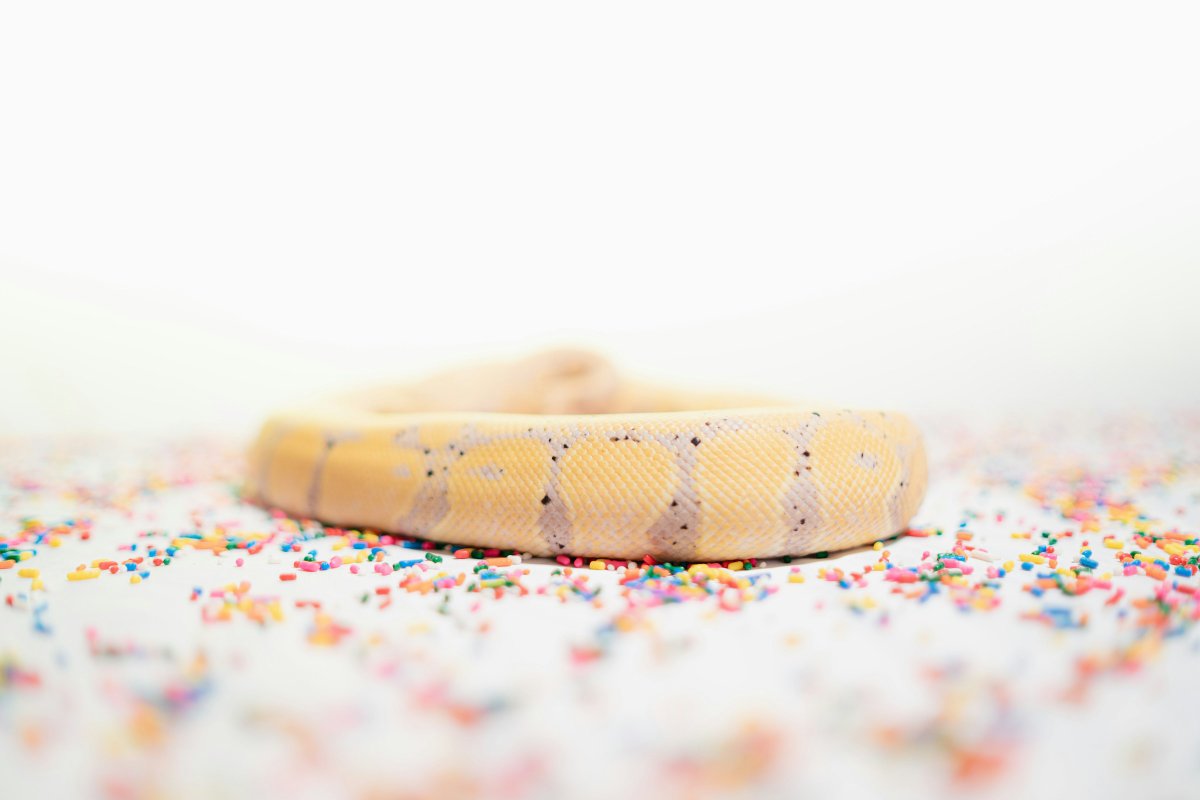
The pairing that breaks the math
Every new breeder eventually hears some version of this: "Mojave and Lesser aren't really different genes — they're the same gene." It sounds like hobby folklore. It's actually the single most important thing to understand before you pair two visually similar co-dominant morphs.
Get it wrong, and a tool that treats every gene as independent will tell you a pairing produces 25% "double dominant" animals that simply don't exist — because what actually comes out of the egg is something else entirely.
What an allelic complex actually is
Genes live at a specific location on a chromosome, called a locus. Most ball python morphs each occupy their own locus, which is why they combine freely — a Pastel and a Spider are unrelated genes, and stacking them just gives you a Bumblebee with both traits visible.
An allelic complex is different: it's a group of morphs that all sit at the same locus. Different mutations, same address. The best-known example is the Lesser complex — Lesser, Mojave, Butter, Russo, Special, and a handful of others. Each looks like its own distinct co-dominant morph on its own. But because they share a locus, pairing any two of them together doesn't give you a double-dominant "super" the way Pastel-to-Pastel would. Instead, one copy of each different allele combines into something the hobby calls Blue-Eyed Leucistic (BEL) — a solid white animal with genuinely blue eyes, and one of the most requested projects in the hobby.
The same pattern shows up in a handful of other complexes too (the "Ivory" group and the "Sunset/Coral Glow" group both work the same way) — different names on the visual morph, same underlying rule.
Where a naive calculator goes wrong
A calculator that doesn't know about allelic relationships treats Mojave and Lesser as two totally separate genes. Pair them, and it will output something like "25% Mojave, 25% Lesser, 25% Mojave+Lesser (double het / super), 25% normal" — plausible-looking math that describes a genotype that can't actually happen, because the two alleles are competing for the same slot rather than stacking.
The correct output for a Mojave x Lesser pairing is 25% Mojave, 25% Lesser, 25% Blue-Eyed Leucistic, and 25% normal-looking. Same four boxes on the Punnett square — completely different four animals.
This isn't a rare edge case. It affects every pairing between two members of the same complex, which covers some of the most commonly kept and commonly paired morphs in the hobby.
What this means for planning a pairing
Before locking two morphs together that look similar or share a naming pattern, it's worth checking whether they belong to the same complex — not just what each one looks like on its own. The signs to watch for:
- Both morphs are described as co-dominant with a "super" form that looks nothing like either single-gene parent
- Community references list them under the same complex name
- The pairing is a known "project" combination in the hobby (BEL pairings are a good example — bred deliberately, not stumbled into)
Built into the math, not bolted on
SKS Exotics' genetics engine knows which morphs are allelic to which, so a Mojave x Lesser pairing returns Blue-Eyed Leucistic in the outcome list automatically — no manual override, no separate lookup. It's one of the details that separates a calculator built to be technically correct from one built to look correct.
Run your own pairing through the free morph calculator — allelic complexes, poss-hets, and all — or track it start to finish inside the collection app, free for up to five animals.